

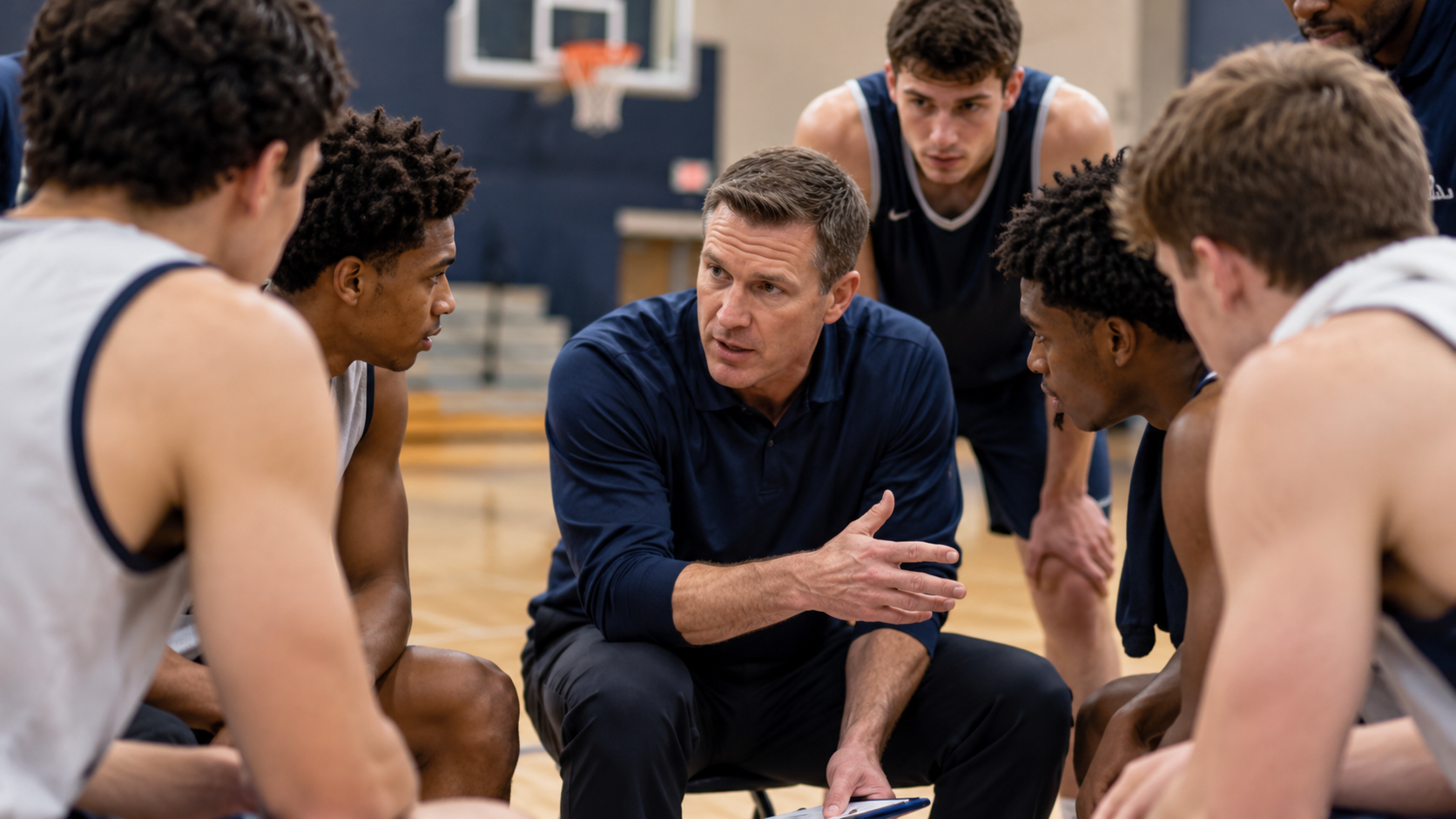
The University of Michigan won the 2026 NCAA basketball national championship with a team that was, in a real sense, brand new. Only three of their top nine players had been on the roster the year before. And 3 of these players who became starters were undervalued, second-tier players on their teams before they transferred. At the center of Michigan’s success was something less tangible than talent: a team that was inspired to learn together, challenge each other honestly, and put team goals ahead of individual ones. Coach Dusty May built this, a culture of psychological safety, consciously and methodically.
The Misconception About Psychological Safety
Most leaders think psychological safety means non-confrontation — lowering the bar, easing off accountability, making work more comfortable. That’s a misread, and it limits the real power of the idea.
Psychological safety isn’t about comfort. It’s about permission to speak up, to be wrong in front of others, to bring your full self to a team that’s counting on you. It’s also a commitment to your own growth and to your teammates’ in service of something bigger. The leaders who get this right don’t trade intensity for safety. They use safety to fuel intensity.
Nobody has made that case more clearly this year than Dusty May.
Safety and Intensity Aren’t Opposites
May draws a sharp line between two modes: when the team is “on the job” — in game time, in practice competition, and in the moments that count. He also wants them to enjoy each other’s company when they’re out of the spotlight. This comradery only elevates performance under pressure. In his words, the program takes pride in psychological safety, wanting players to be who they are even when others are counting on them to perform with intensity and professionalism.
That distinction matters more than it sounds. May isn’t asking his team to relax their standards. He’s saying that comfort being their authentic selves is what lets them meet those standards. He believes that a team that trusts each other off the court plays looser, communicates faster, and recovers quicker from mistakes on the court and under pressure. This isn’t a soft skill bolted onto a hard-nosed program. It’s structural to how the program wins. As May put it, the goal is a team that competes hard “but isn’t afraid of the failure that can come with losing.”
Psychological Safety Isn’t Just a Sports Problem
Swap “locker room” for “design team,” “manufacturing cell,” or “branch office,” and the pattern holds. Teams fail when they can’t admit an error until it’s a crisis; where the real conversations happen in the parking lot instead of the meeting room; where “we’re all professionals here” becomes code for nobody saying the hard thing out loud.
The organizations that outperform aren’t the ones with the least friction, they’re the ones where friction surfaces early, while it’s still cheap to fix, and where people solve problems together without waiting to be told. That’s true whether you’re managing a P&L or a possession with six seconds on the clock.
How Dusty May Built Psychological Safety
May didn’t stumble into this — he studied it, deliberately, the same way he’d study an opponent’s defense.
Build a Culture of Error
He built a culture of error. May has an ongoing relationship with Doug Lemov, the educator behind Teach Like a Champion, and sends him film of his own teaching sessions with players for critique. The goal is an environment where players can think critically and get things wrong without their mistakes being judged — a culture of error. He treats his own coaching the way he’d treat game film: something to study, refine, and be held accountable for. That extends to how he talks about his own mistakes with the team: he tells players he’ll make more mistakes than all of them combined, and what matters is that they can trust he’s working to fix and learn from them. And that’s what he expects from them.
Study the Discipline, Not Just the Outcome
He studied the discipline, not just the outcome. While at Florida Atlantic, May read J.P. Nerbun’s book The Culture System and worked through Nerbun’s webinars — material originally built for high school coaches. A Division I head coach going back to that level of material to learn culture-building is a good reminder that this isn’t a skill reserved for people who’ve already arrived.
Hand the Thinking Back to the Team
He hands the thinking back to the team. May has described a real shift in his own approach. Early on, he wanted to be the reason things got figured out. Now, he wants to lead players toward the answer and let them find it. He realized that decision-making and autonomy get built in the practice environment, not handed down from the sideline. He believes high-IQ teams come out of collaboration and vulnerability, not top-down instruction: “we should all be learning from each other, and from every opponent.” Win or lose, he asks the same question afterward: “what can we learn from them?”
Fun Without Losing Focus
Here’s where leaders tend to get it wrong in one direction or the other: they assume safety and seriousness can’t coexist, so they either run a tight ship with no room to breathe, or a loose one that drifts. May’s team does neither.
The roster has real range: intensely competitive leaders alongside teammates who keep the locker room loose. And May facilitates both. May uses fun, personal, and internal nicknames to keep things light. One player picked up a nickname after a spirited, goofy moment in practice. It’s a small thing. It also signals that the team can take the game seriously without taking themselves too seriously. This reinforces a culture built around shared goals over individual acclaim.
All-time great coach John Wooden, asked once about the secret to his success, offered that there was a lot of love in his coaching. Directness, pushing players to be their best, and genuine enjoyment of the people in the room aren’t in tension. That combination is what love looks like in a competitive environment, and it’s present in how May leads. As he’s put it, even going through hard stretches with a teammate can become something you value, a way of redefining what “fun” actually means on a team.
That’s the real skill: not choosing between fun and focus, but knowing, moment to moment, which one the situation calls for, and building a team secure enough to move between them without losing itself.
Elliot Cadeau: Psychological Safety in Action
Point guard Elliot Cadeau is a testimonial to the effect of Dusty’s culture of psychological safety.
Cadeau was a star recruit out of high school, landing at North Carolina — a perennial powerhouse. He started strong as a freshman, but by his sophomore year, his play had grown inconsistent and his confidence visibly wavered. Looking at his Game Score — a composite stat that captures a player’s overall effectiveness in a game, and evaluating it against the season’s toughest opponents, his sophomore-year average sat at just 5.2.
He transferred to Michigan for his junior year. In the first half of the season, that same measure against elite competition wasn’t much better at 6.4. But as the year went on, something shifted: he grew more fearless and more comfortable running the offense as a leader. That’s a common signature of psychological safety taking hold. Over the second half of the season, against arguably even better competition in the Big 10 and NCAA tournaments, his average nearly doubled to 11.1. By season’s end, Dusty May’s culture had helped turn a struggling sophomore at North Carolina into the Final Four’s Most Outstanding Player.
What Psychological Safety Looks Like Day to Day
Asked what this looks like in practice, May’s answers are less about systems and more about posture:
Separating your own ego from the situation, so you can move forward with more self-awareness.
Slowing yourself down and managing your own impulses before you ask your team to manage theirs.
Telling your team, daily, that they matter; not just performance feedback, but that they’re valued as people. When guard LJ Cason tore his ACL, he shifted into a role of supporting, encouraging, and inspiring his teammates from the sideline — something May has called one of the things he’s most proud of in the championship season.
Showing your team, consistently, that you’ll do anything for them.
None of that is complicated. It’s also not easy to sustain under the pressure of a season where the stakes climb every week. But when sustained it pays dividends in team performance and both professional and personal growth. It is magical.
The Takeaway for Leaders
Leaders who build this kind of distinction into their own teams (permission to be themselves without lowered standards and seriousness without rigidity), aren’t running a looser operation. They’re running a faster, more honest one. And if Michigan’s season is any indication, a more successful one too.